
Market lifecycle
event_status is the only lifecycle signal in the Market Registry API. Every market on an event shares its event's status. The API does not return a per-market status or outcome; outcomes reach your platform as agreed with Chainlink. See Outcome delivery.
Event statuses
event_status | Meaning |
|---|---|
scheduled | The event has not started. |
live | The event is in progress. No outcome is ready. |
postponed | The event is delayed and can be rescheduled. A new scheduled_start appears when it is. |
final | Every market reached a terminal state. Outcomes are determined, except for markets that were cancelled. Delivery can still be in progress. |
completed | Resolution, and delivery where configured, are complete. |
cancelled | The event will not occur. |
unsafe | At least one market has missing or conflicting evidence. Nothing is delivered for it. The engine keeps checking. |
unsafe is not terminal. A later round of evidence can move the event back to final. A market that stays unsafe never receives an outcome, and an absent outcome is not NO.
To list events in particular statuses, pass status to /events. Repeat it to match several.
Transitions
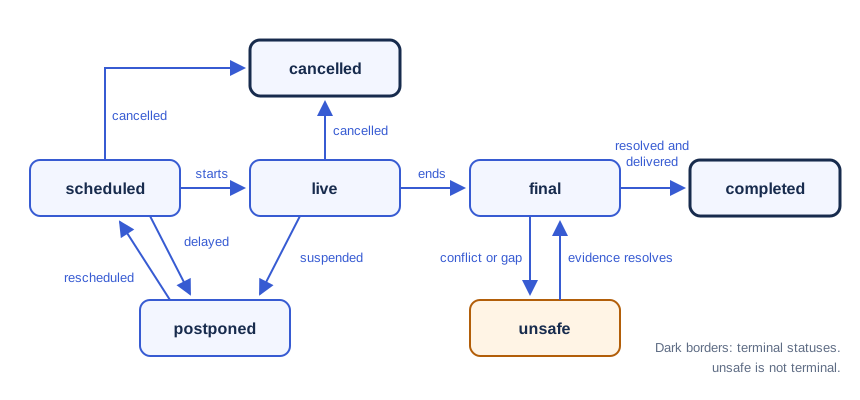
| From | To | When |
|---|---|---|
scheduled | live | The event starts. |
live | final | The event ends and outcomes are determined. |
final | completed | Resolution and delivery are complete. |
final | unsafe | Evidence is missing or conflicting. |
unsafe | final | The evidence resolves. |
scheduled | postponed | The event is delayed. |
live | postponed | The event is suspended. |
postponed | scheduled | The event is rescheduled. |
scheduled or live | cancelled | The event is cancelled. |
completed and cancelled are terminal for resolution. If a provider relists a cancelled event under the same fixture, the event returns to the catalog with the same slug. A relisting under a new fixture is a new event with a new slug.
Rescheduling
A rescheduled event keeps its slug. The date in an event slug is part of the identifier, not the current schedule; read scheduled_start for timing. Because /events filters by scheduled_start, a rescheduled event can move into or out of a date window.
Resolution timing
Resolution follows the real end of the event, not its scheduled start: the engine resolves once the data providers confirm a final result and agree. Overtime, extra innings, and delays move that point. Resolution takes longer when providers are slow to mark a result final, or while the event is unsafe.
Next steps
- Track event status: Read these statuses from the API.
- Trust and failure handling: Why an event becomes
unsafe.